Pakistan, Saudi Arabia, and Turkey Send Joint Diplomatic Mission to Tehran
Leaders from the new Mecca defense pact met with Iranian President Masoud Pezeshkian on Monday to discuss regional security ahead of the US midterm election on November 3.
By John Laurent ·
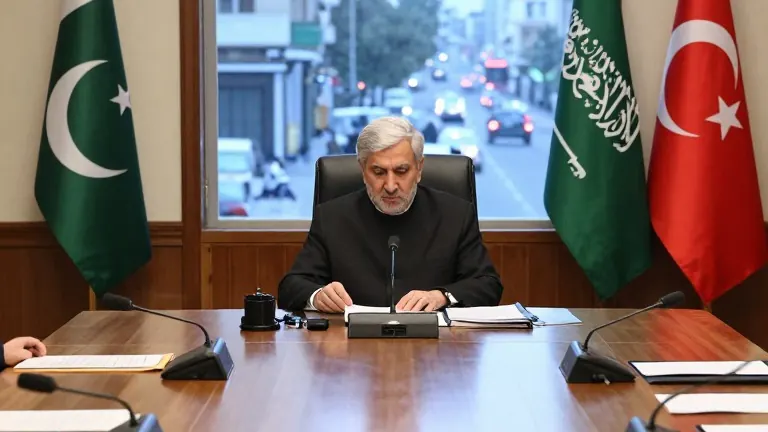
Regional diplomacy accelerated on Monday as top security officials from Pakistan, Saudi Arabia, and Turkey arrived in Tehran to meet with Iranian President Masoud Pezeshkian and other senior government figures.
The three envoys represented the Mecca defense pact, a military alliance officially established this summer between Islamabad, Riyadh, and Ankara. Their joint visit aimed to open negotiating channels and prevent a return to military escalation, according to Saudi Arabia.
A senior Pakistani official told Reuters that the discussions covered the creation of a regional non-aggression network. The agenda also included US-Iran talks, Houthi rebel attacks on Saudi infrastructure, the status of the Strait of Hormuz, and the ongoing US naval blockade. The official said Pakistan's army chief, Asim Munir, proposed a conflict resolution plan involving the three Mecca states and Qatar as mediators. The source noted that US President Donald Trump previously approved Munir's diplomatic efforts.
Iran described the meeting as taking place in a "very positive atmosphere." Mohsen Rezaei, head of Iran's Supreme National Security Council, told state television that "very good discussions took place" and that a new regional atmosphere is emerging. He argued that West Asian countries should build their own security without outside intervention. The next day, Rezaei met with Supreme Leader Mojtaba Khamenei, who called for protecting Iranian interests while maintaining Tehran's current conditions for ending the war.
Analyst Babak Dorbeiki, a former official at Iran's Strategic Research Center, said the simultaneous presence of the three senior representatives signaled that the nations are acting as a unified bloc. He noted that the Mecca pact is designed primarily for deterrence rather than offensive war. Dorbeiki observed that the alliance gives Saudi Arabia access to Pakistan's nuclear capability and Turkey's conventional military strength, which helps counter Iran's influence and Houthi attacks on Saudi infrastructure.
Saudi Arabia faces a difficult choice between enduring further Houthi damage or risking a wider war that could threaten its economic development projects. Dorbeiki stated that Saudi Arabia prefers a diplomatic solution because both the current status quo and a full-scale war carry serious costs. Pakistan also seeks to avoid direct conflict to keep its focus on security concerns involving India, while Turkey, a NATO member, took a cautious approach by sending its intelligence chief, Ibrahim Kalin, instead of its foreign or defense minister.
Iran's media advisor, Ali Asghar Shafieian, rejected the idea that the meeting served as an ultimatum before an attack. He said the three countries likely wanted to demonstrate their growing coordination while showing Iran remains part of regional diplomacy. Shafieian added that Iran is preparing for possible conflict while maintaining negotiations, similar to the military preparations of the US and Israel. He said an agreement remains possible if Iran's political standing and national dignity are respected.
Dorbeiki argued that Iran is using negotiations to buy time without making real-world commitments. He suggested Iran might trade influence over Houthi attacks for concessions such as an end to US military pressure. The primary outcome of the Tehran meeting is to keep diplomatic channels open, signaling to Iran that it remains a partner rather than an enemy.
Source: Deutsche Welle