Texas map redraw triggers national redistricting fight
A 71% majority of Americans oppose partisan maps, yet a new Texas law has forced states to redraw districts ahead of the 2026 midterms.
By Thomas Schneider ·
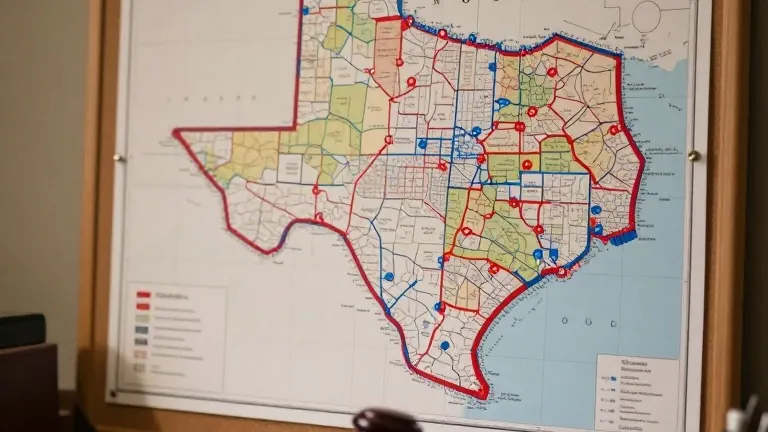
President Donald Trump asked Texas to redraw its congressional map in the summer of 2025, seeking to secure up to five additional seats for Republicans. The request challenged the standard practice of updating maps only once per decade after a census. Trump aimed to protect the Republican hold on the U.S. House ahead of the 2026 midterm elections, a cycle historically difficult for the party holding the White House.
Governor Greg Abbott directed state lawmakers to return to Austin to draft the new lines. The Texas House produced a plan intended to flip five districts from blue to red. Democrats in the state legislature initially attempted to block the vote by leaving the state. This tactic broke the required quorum of 100 members out of 150, delaying the legislative process for several weeks. Upon their return, lawmakers voted the new map into law.
The Texas action triggered a cascade of redistricting efforts across the country. SMU political science professor Matthew Wilson described the situation as a partisan tit for tat. California and other states moved quickly to respond to the Texas changes. This back and forth between Democratic and Republican states has created a series of legal and political battles that extend beyond the Lone Star State.
Gerrymandering relies on two primary tactics: cracking and packing. Cracking divides a group of voters across multiple districts to dilute their influence. Packing concentrates a specific group into the fewest possible districts, giving them overwhelming majorities in limited areas while weakening their presence elsewhere. These methods have been used for centuries, though the current conflict centers on the speed and purpose of the changes.
The practice remains legal under current Supreme Court precedent. In 2019, the Court ruled that excessive gerrymandering does not violate the Constitution, leaving federal courts without the authority to determine when a map goes too far. Wilson noted that a political party is not a protected class. However, mapmakers cannot use racial or ethnic groups as their primary intention for disenfranchisement.
Public opinion opposes the current trend. A recent YouGov poll found that 71 percent of Americans believe states should not draw districts to intentionally favor one party. Wilson observed that many voters remain preoccupied with daily life and have not prioritized this issue. He suggested that voters generally prefer competitive elections where districts can legitimately swing either way, rather than the overwhelming party dominance seen in many current maps.
Source: KTVT