Texas Early Voting Trails 2018 Pace; 19 Million Registered
Nearly 4.5 million Texans voted in the first week, while analysts debate what the party makeup of those ballots means for the Nov. 3 election.
By John Laurent ·
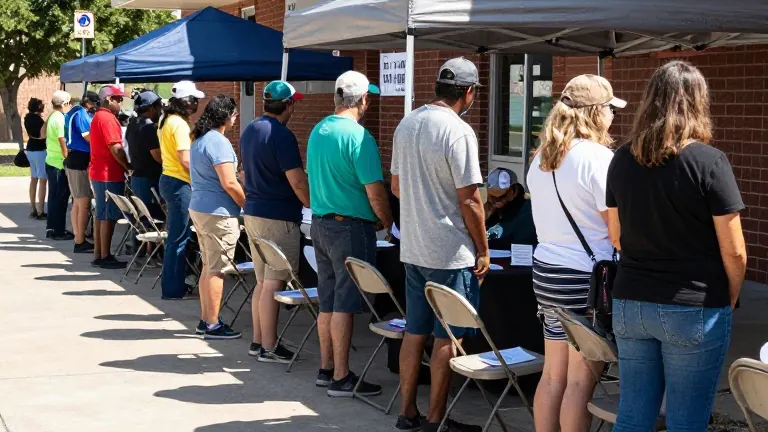
Nearly 4.5 million Texans cast a ballot in the first seven days of early voting, a pace that trails the 2018 midterm cycle but runs ahead of 2022. From Oct. 19 through Sunday, 23.4% of registered voters had voted in person or by mail, according to the Texas secretary of state. In 2018, the first-week figure was 24.3%.
The state has 19 million registered voters for the Nov. 3 election, up 7.7% from the registration count before the November 2022 midterm. Early voting closes Friday, and Election Day follows on Nov. 3.
Derek Ryan, a Republican consultant and data analyst, expects turnout to rise through the middle of the week. "We could see anywhere between maybe 20 to 30% of the votes that get cast in this election get cast on Wednesday, Thursday and Friday this week," Ryan said. He projects as many as 10 million Texans may vote, near the 53% turnout recorded in 2018.
Ryan's breakdown of the first seven days shows voters with a Democratic primary history accounted for 35% of ballots cast, compared with 33% for those with a Republican primary history. Another 29% had no prior primary participation or had voted only in general elections, while 4% had split primary histories. Ryan called the Democratic share new territory, saying he does not recall a point where Democratic primary voters outnumbered Republican primary voters.
Vinny Minchillo, a GOP strategist, said the early Democratic numbers reflect higher enthusiasm on that side but have also pushed Republican participation. "Their enthusiasm numbers and polls are not what the Democrats are, but that doesn't mean they're not going to show up," Minchillo said. "After the first or second day of early voting, you've seen Republicans getting out."
Mark Jones, a political science professor at Rice University, cautioned against reading too much into the tallies. "I think there's sometimes a tendency to over-interpret early vote numbers because we don't have good benchmarks," Jones said. Texas does not register voters by party, and counties report results to the state daily, so the partisan makeup of early ballots cannot be determined directly.
Matt Angle, a Democratic strategist, pointed to where the ballots are coming from. He said Democrats want roughly 40% of the final vote from large urban counties and under 25% from rural counties, and that the early returns meet those marks. Harris County recorded more than 127,000 votes on day one of early voting, a midterm first-day record, and Dallas County logged more than 88,000, a record for day one of any election.
Ryan said he is tracking more than 2.1 million Texans who voted in one of the last four Republican primaries but have not yet cast a general election ballot. "For Republicans to have any chance of victory, they're going to need to see a significant number of that 2.1 million to show up to vote," Ryan said. "We'll start really knowing what the picture looks like by Thursday or Friday."
Source: San Antonio Current